

The Hidden Costs of Remote Hiring : What Startups Overlook Until It’s Too Late

March 9, 2026
Remote hiring has become every startup’s secret advantage. Access to global talent, lower costs, and faster scaling sound irresistible - until the hidden complexities start showing up on balance sheets and in workflows. What looks cheaper on paper can become more expensive in execution if you don’t plan for the unseen layers of cross-border employment.
True cost efficiency is about controlling risk and building sustainability. Let’s break down the hidden costs of remote hiring, how to avoid them, and how companies in 2026 are building smarter budgets for distributed work.
For founders, the biggest appeal of remote hiring is straightforward: access top talent for less. Wages in emerging markets may run 30–70% below Western averages. But that’s only one line of the ledger. The full cost of global employment includes technology infrastructure, compliance, management overhead, and retention.
When startups forget to model those variables, the “cheap” talent equation collapses into operational chaos.
Example: An early-stage company hires engineers in three regions. Payroll is half the U.S. rate, but coordination across time zones doubles project timelines. Savings vanish in delayed launches and lost revenue.
The lesson: measure total output cost, not hourly wage.
Learn more about what it actually costs to hire and employ in different countries via our global expansion playbook.
Hiring talent across countries without proper employment structure can lead to misclassification—treating someone as a contractor when local law considers them an employee. It’s the most expensive remote hiring mistake a startup can make.
Penalties range from back taxes and unpaid benefits to legal sanctions and reputation damage. In some countries, those costs extend retroactively for years.
By 2026, most scaling companies avoid this risk by using EOR (Employer of Record) partners to handle local compliance. The marginal fee, about 10–15% per employee, is far cheaper than potential penalties that can reach six figures per violation.
Real hidden cost: Regulatory fines, legal fees, and forced employee conversions.

Distributed teams stretch across continents, often without realizing how much the calendar friction costs. Every delay in feedback, decision-making, or meeting overlap drags productivity.
If your leadership team is in London, engineering in Kuala Lumpur, and marketing in São Paulo, collaboration naturally slows down. Tasks that should take a day stretch to three because of async lag. Multiply that delay across quarters, and your “savings” dissolve into opportunity loss.
Smart companies counter this in two ways:
Real hidden cost: Lost time equals lost revenue.
Each new geography brings management complexity: language barriers, cultural nuance, and shifting labor laws. Leaders spend extra hours clarifying, following up, and maintaining alignment. Without processes, that time compounds silently.
The hidden budget drain: higher manager‑to‑employee ratios. Companies often hire two additional coordinators or ops specialists just to manage globally, adding unplanned payroll.
The fix is to build structured communication cadences and document heavy rather than meeting heavy systems. Let written clarity replace managerial babysitting.

Security compliance has become one of 2026’s major remote costs. Data protection laws (GDPR, LGPD, HIPAA, local equivalents) require secure networks, encrypted devices, and region‑specific data storage—all of which raise IT budgets.
Add recurring software licenses, VPN access, and endpoint monitoring, and your per‑employee cost rises sharply. Remote setups need corporate‑grade cybersecurity, not just webcams and Wi‑Fi.
Checklist for lean security compliance:
Real hidden cost: Breach fines and data‑handling penalties.
Paying international staff means living with currency volatility. Payroll processed in pesos, rupees, or naira can fluctuate monthly, eroding predictable budgets.
Startups also face tax complexity—double‑taxation risks, VAT differences, or unexpected withholding obligations when paying contractors. Exchange fees and remittance charges further eat into savings.
Using multi‑currency payroll systems or EOR partners that hedge conversions upfront stabilizes this cost. Always model a 5–10% variability buffer into global compensation planning.
Real hidden cost: Currency exposure and financial unpredictability.
Too many startups hire globally but forget to integrate those hires meaningfully. Offshore teammates often feel peripheral, leading to faster burnout and turnover. Replacing a skilled global engineer costs time and recruitment capital that far outweigh the wage difference.
Remote culture isn’t self‑sustaining—it needs deliberate investment in recognition, learning, and career paths. Budget for:
A strong remote employer brand retains people longer, stabilizing productivity and offsetting the churn tax.
Real hidden cost: High attrition and rehiring expenses.
When you eventually grow large enough in a region, maintaining long‑term compliance may require establishing a local entity. Incorporation, legal counsel, annual audits, and government registrations quickly cross $20,000 per country unless you have a company like Fronted supporting you.
Equally, off‑boarding is riskier abroad. Some countries require formal notice periods, severance multipliers, or union approvals. Without local expertise, a single misstep during termination can trigger litigation or back pay orders.
Using experts early avoids these commitments until scale justifies them.
Real hidden cost: Legal entanglement when scaling or off‑boarding internationally.
We help companies setup legal entities. Save months on company setup and 50-80% on your monthly running costs. Fronted is your one-stop-shop for global employment & company infrastructure. Learn more here.
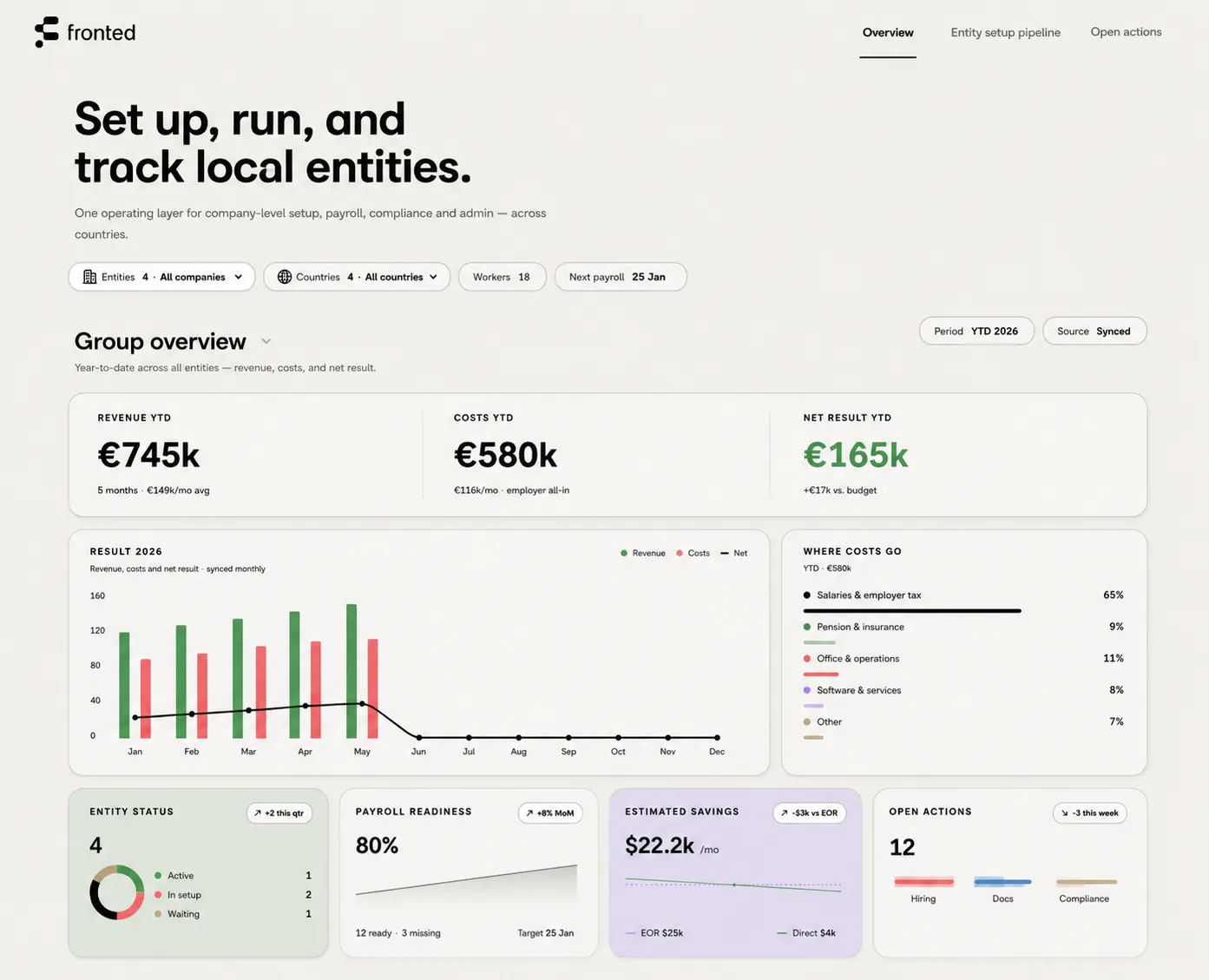
Hidden costs don’t always appear in spreadsheets- they appear in slowed collaboration, duplicated work, and misunderstood expectations. Cultural misreads lead to missed deadlines and uneven output quality.
Founders underestimate how much cultural literacy improves efficiency. Regular cross‑cultural training, shared communication handbooks, and onboarding workshops dramatically cut miscommunication.
Real hidden cost: Reduced speed due to cultural friction.
In remote organizations, every department buys its own stack—Slack, Notion, Asana, JIRA, local payroll platforms, VPNs, and survey tools. Licensing overlaps explode yearly budgets without anyone noticing.
Conduct semi‑annual tool audits to consolidate vendors. Choosing one integrated HR platform with global payroll, document storage, and analytics saves both money and cognitive load.
Real hidden cost: Redundant software subscriptions and fragmented data.
When your workforce is everywhere, culture becomes the product you ship internally. Neglecting consistent experiences leads to fragmented identity and weaker loyalty.
Investing in brand‑aligned internal communication- regular all hands, consistent visual language, or shared traditions—creates cohesive culture across borders. Though intangible, strong internal branding reduces turnover and boosts external employer reputation.
Real hidden cost: Disconnected teams and eroding culture equity.
Smart financial modeling in 2026 goes beyond headcount and salary. Realistic global hiring budgets now include six buckets:
When leadership sees hiring through that lens, global growth feels like an investment, not a gamble.
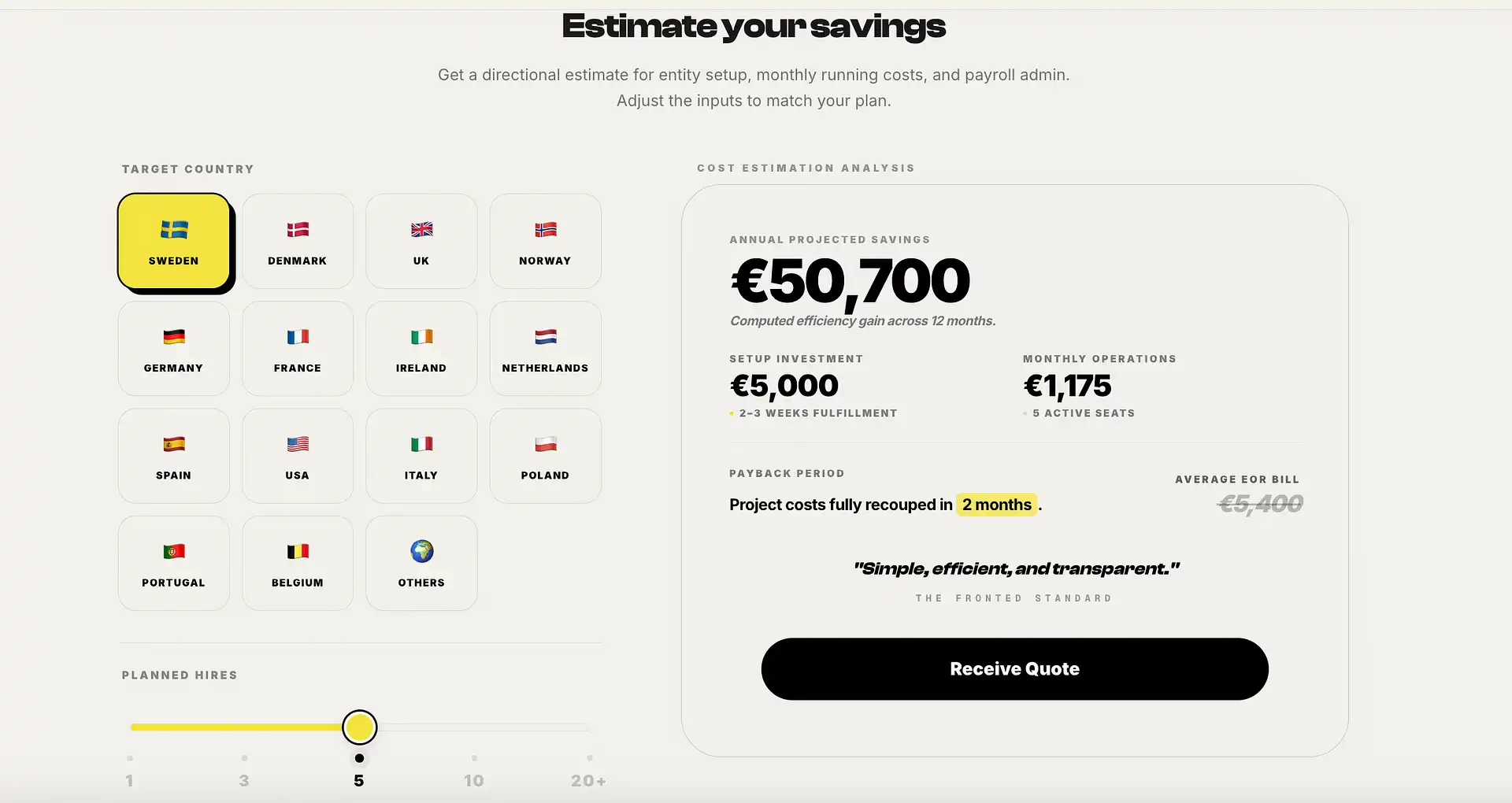
Modern employment partners like Fronted centralize all these hidden layers. A single dashboard integrates:
Visibility converts uncertainty into strategy. You can expand confidently knowing every cost variable is accounted for, from Lagos to Lisbon.
Remote hiring is powerful, but not automatically cheaper. The world’s most sustainable companies in 2026 treat distributed employment as both opportunity and responsibility. They look past visible salaries to uncover the full cost ecosystem, compliance, culture, and continuity.
Global hiring isn’t about finding the lowest rate; it’s about building teams that last. Once you budget for the invisible, you turn remote and flexible work from a savings tactic into a long‑term growth engine.
Need support with your global expansion? Talk to someone from our team.
Talk with Fronted today.


